


video tutorials for social media
What does open caption mean? (Movies, subtitles, & more)
Have you ever noticed text appearing at the bottom of a movie screen that you cannot turn off? Or maybe a movie listing you saw in a theater with “open caption” label and wondered what that meant?
Open captions are a type of captions that are becoming common in movie theaters, streaming platforms, and social media. Learning what are open captions is useful for people for a variety of people, including those who are hard of hearing, learning a new language, or simply like to watch content on silent with captions.
In this guide, we’ll explain what open captions mean, how they work in different settings, and how they are different from closed captions.
What does open caption mean?
Open captions are text displayed on a video or movie screen that cannot be turned off. The word “open” means that captions are always visible to everyone watching. In other words, these captions/subtitles are embedded or burned-in into the video itself.
If you’ve ever watched a foreign film with subtitles burned directly onto the screen, it means you’ve seen open captions. They are different from closed captions because viewers cannot toggle on or off through their TV settings or streaming platform. Open captions, by nature, are part of the video file itself.
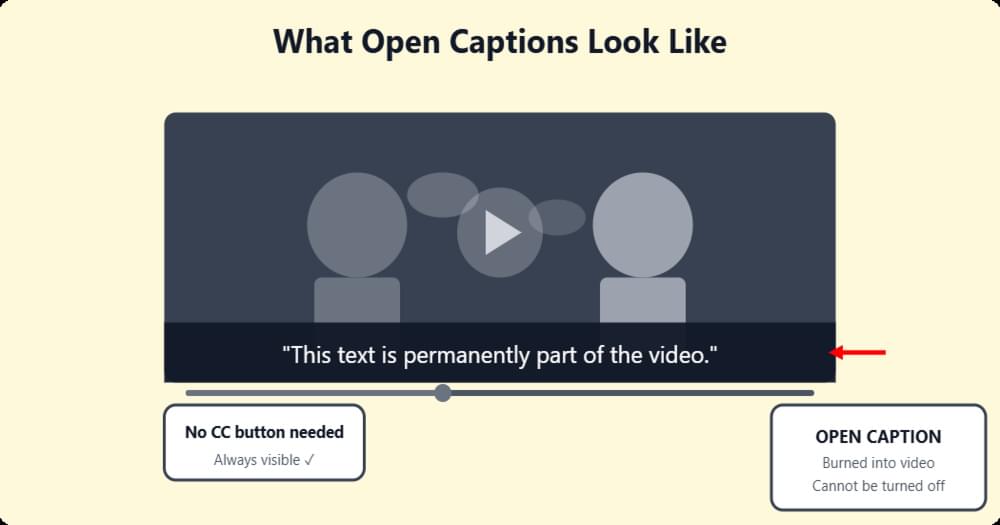
This type of setting is useful in situations where you cannot control caption settings, like watching videos on social media with autoplay or viewing content in a public space where the sound is muted.
Related: Understanding the difference between subtitles and captions
What does open caption mean in movies?
Open captions have multiple benefits and use cases in movies. Generally, open captions in movies are used to translate foreign language dialogues. For example, if you are watching an English-language film and one of the characters starts speaking a foreign language like Spanish, the translation will appear on the screen in the form of an option caption, which means it is burned into the movie.
But other than captioning and translating, many filmmakers also use open captions to creatively show time stamps, character thoughts, and location names.
What does open caption mean in a movie theater?
While theatrical releases normally don’t have open captions, some cinemas and movie theaters have started to include open captions to make the movies accessible to a larger audience, and especially for those with hearing issues.
These versions of the movies with open captions have dialogue, sound effects, and any other relevant audio information.
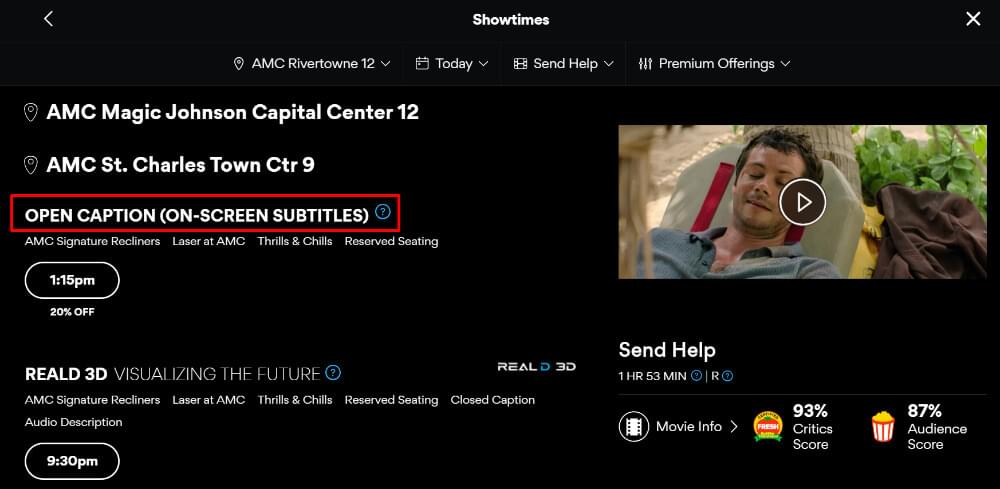
Some major theater chains like AMC have dedicated showtimes for films with open captions. You can usually find the “Open Caption (On-Screen Subtitles)” label on movie’s ticket on the cinema’s website. Moreover, if the theater say something like “presented in open caption”, it means the screening will have captions displaying throughout the film.
Also read: 6 benefits of watching videos with subtitles
Uses of open captions
The uses and benefits of open captions extend far beyond movie theaters and films. You are likely to encounter open captions in a wide range of content.
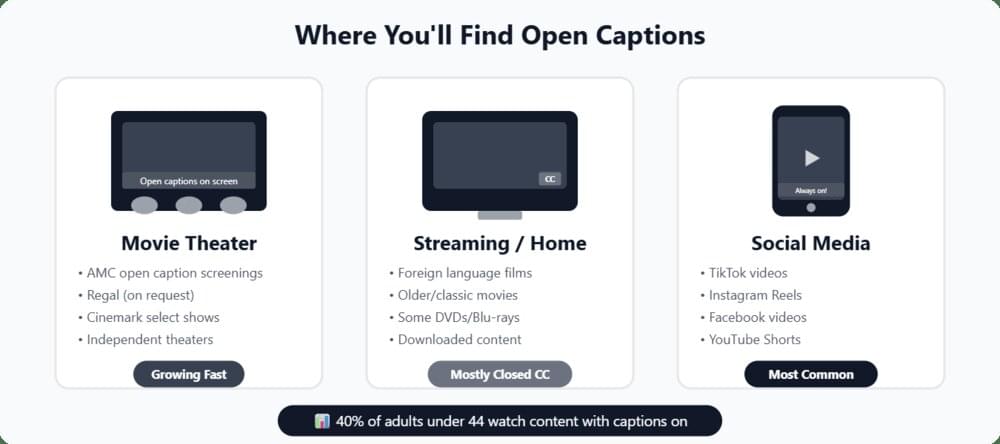
Social media content
Open captions are the dominant type of captions across all social media platforms, including TikTok, Instagram Reels, YouTube Shorts, and Facebook. The fact that 85% of mobile videos are watched on mute further cements the importance of open captions to capture users’ attention.
Content creators can also be rest assured that by hardcoding captions into the videos, every social media platform’s algorithm will prefer to boost their content due to higher engagement and accessibility.
Corporate training and presentations
Many organizations also use open captions for internal communications, onboarding content, and training videos. This is helpful to ensure all employees can properly follow the content, and individuals with hearing issues or who speak English as a second language don’t have any issues in understanding it.
Open captions are also known to facilitate comprehension and retention. When the employees are able to hear and read the information simultaneously, they’ll be able to absorb complex information and retain it for a long period of time.
Public displays and digital signage
Airports, hospitals, gyms, retail stores, and transit systems also use open captions because audio is not practical in these situations. Burned-in text is vital to get the message through the screen in a noisy environment.
Education and e-learning
Open captions also have significant uses in the education field. It can improve comprehension for all students, not just those with hearing impairments. They’re especially valuable for second-language learners by allowing students to review recorded lectures or anyone studying in environments where audio is not possible or not properly heard.
Related: Top 10 benefits of subtitles and captions
Why open captions matter for engagement?
The benefits of open captions in higher engagement is proven by several stats and figures:
1. Higher completion rates: A study from Verizon and Publicis Media has found that up to 80% of viewers are likely to finish a video if it has subtitles.
2. Improve engagement: Videos with captions have a higher engagement and retention rate. Captioned videos can retain viewer for longer than the videos without subtitles.
3. Greater reach: Since option captions make your content accessible to people hard of hearing, you can have a broader reach. Moreover, it also helps you reach non-native speakers.
4. Better comprehension: Viewers with perfect hearing also prefer captions as they help in better comprehension of unclear dialogues, heavy accents, and noisy environments.
Key differences between open caption vs closed caption
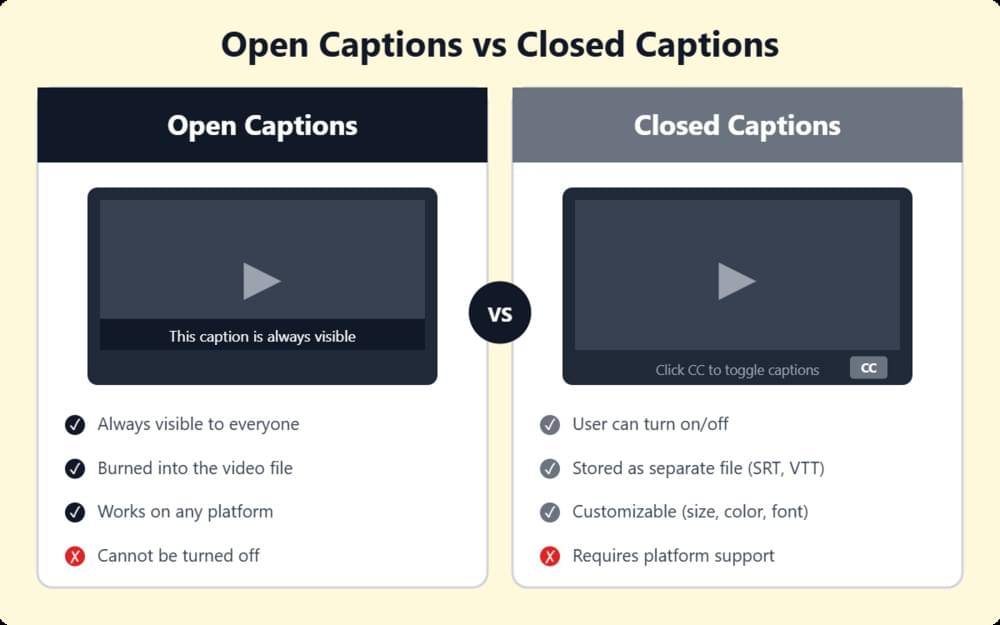
Closed captions are quite different from open captions. The following table summarizes the key differences between open captions vs closed captions:
| Feature | Open Captions | Closed Captions |
|---|---|---|
| Visibility | Always on, cannot be turned off | Can be toggled on or off |
| Location | Burned into the video file | Stored in a separate file (e.g., SRT) |
| Customization | Fixed appearance (hardcoded subtitles) | Often adjustable (size, color, font) |
| Platform requirements | Work everywhere | Require platform support |
Generally, you should:
- Use open captions for: social media content, public displays, platforms without closed caption support, and when you want to ensure subtitles visibility for all viewers.
- Use closed captions for: long-form streaming content, videos where viewer preference can vary, multilingual caption options, and SEO-focused content where searchability is important.
Related: What are SDH Subtitles? Difference in SDH and Closed Captions
Conclusion
The bottom line is that open captions are highly useful for all kinds of video content. Whether you are creating content for social media, educational videos, or professional presentations, you should add open captions in them to ensure your message reaches the target audience, even if they are watching the video on mute.
The best part is that you generate open captions for your videos in a few minutes with an AI-powered subtitle generator like SubtitleBee. All you have to do is upload the video and let AI generate accurate burned-in captions with 99% accuracy. So, try out SubtitleBee for free and explore it to make your videos more accessible.
FAQs about open captions
What is the difference between open captions and subtitles?
Open captions are hardcoded / permanently burned into a video and cannot be turned off. On the other hand, subtitles are text that is typically optional to translate dialogue for viewers who can hear the audio. Open captions include all audio information, such as sounds and dialogue for higher accessibility, while subtitles is focused on translating speech to text.
Can you turn off open captions?
No, open captions cannot be turned off. They are embedded directly into the video file, so they’re permanently part of the visual content. If you find the burned-in subtitles or open captions to be distracting, you’ll need to find a version that offers closed captions instead.
Why do some movies have open captions?
Movies include open captions for several reasons: translating foreign language dialogue, displaying on-screen text as part of the story, and providing accessibility for hard of hearing audiences. New state laws in places like Maryland and Washington also now require theaters to offer open caption screenings for greater availability.
Are open captions the same as subtitles?
Open captions and subtitles are similar but not identical. Subtitles translate dialogue for viewers who don’t understand the spoken language. Open captions are mainly designed for deaf and hard-of-hearing viewers. They also include dialogue plus descriptions of sound effects, music, and speaker identification.
How do I find open caption movie showtimes?
You can check your local theater’s website or app to look for showtimes that have the label “Open Caption,” “On-Screen Subtitles,” or “OC.” Generally, theater chains like AMC, Cinemark and some Regal locations have screenings with open captions.



Add and translate your subtitles to more than 100 languages with high accuracy
Our solution
SubtitleBee
Make your video understandable by using SubtitleBee for free
Start now for freeTop Articles

Getting Started with AI-Powered SubtitleBee

3 Effective Ways To Add Subtitles To Video Online Without Watermark
VEED vs. Kapwing: Which Subtitle Generator wins?
Kapwing vs. SubtitleBee: Which subtitling tool should you choose?

5 Top Verbit Alternatives for Transcription